This week we worked on putting data into bar graphs. The kids were given a table containing data, and
they had to decipher the table and decide which type of bar graph would best
suit it - a double bar graph, or a single bar graph. We made the graphs on
the Mac books, then came up with some questions that go with the graph. Today,
the kids will attempt to answer some of these question on other kids' graphs.
Friday, April 3, 2015
Bar Graphs
Posted by Rebecca May at 7:14 AM 0 comments
Labels: 4th grade, Bar Graphs, Data, math
Tuesday, February 17, 2015
Finding the Area of Irregular Shapes
| Shape 1 |
| Shape 1 with Missing Sides |
| Shape 1 Completed |
| Shape 2 |
| Shape 2 Missing Sides |
| Shape 2 Completed |
Posted by Rebecca May at 8:37 AM 0 comments
Monday, December 1, 2014
Introduction to Fractions
We have started to discuss fractions! By 4th grade, the kiddos have had a ton of
practice naming fractions of a shape, as well as naming fractions of a set of objects. We continued that practice and discussed
the definitions of the numerator and denominator. We also extended our
knowledge by figuring out how to find fractions of a number, such as 12 and 24.
We began by pulling out 12 squares and physically dividing them up into equal
groups. It didn't take the kids long to figure out that to find fractions of a
number, all they had to do was divide the number by the denominator of the
fraction they were looking to find. For example, if they want to find 1/4 of 24,
they could just divide 24 into 4 equal groups. Since 6 would be in each group,
1/4 of 24 is 6. Finally, we discussed how, if we found 1/4, we could also find
2/4, 3/4, etc.
+edit.jpg)
![]() |
| Finding fractions of 24 |
Posted by Rebecca May at 7:30 AM 0 comments
Labels: 4th grade, division, Equivalent Fractions
Friday, November 7, 2014
Describing Relationships Among Numbers in a Table
When we talk about relationships between numbers on a table, we really go two different directions with it. First, we dipped our toes into algebraic thinking by discussing variables and algebraic expressions. We used variables to look at different tables and either determine the rule of the table, or use the rule to fill in missing information in the table.
Secondly, we discussed different ways we can describe a table. Developmentally, this is harder for a 4th grader than you might think. We began by looking at the relationship between the numbers 1 and 5. I asked the kids to think of a real-life relationship between 1 and 5. Someone said hands and fingers. We started discussing how many fingers are on 1 hand, 3 hands, 6 hands, etc. I asked them how we might organize our information so that we could see the relationship more clearly. We decided to make a table. Once our table was made, we looked at our relationship and came up with ways to describe it. The hardest part about this is that the kids tend to want to describe it in a way that is opposite of what is actually happening. For example, one of the ways our table was described was, "The number of hands is the number of fingers multiplied by 5." This is opposite of what is really there. This is a very common mistake for 4th graders! It led to a great discussion, though, about looking at what is reasonable. Could we ever have more hands than fingers? Not unless we'd had some very unfortunate circumstances. ;)
Posted by Rebecca May at 7:57 AM 0 comments
Labels: 4th grade, division, multiplication, Relationships, Tables
Friday, October 24, 2014
Forms of Energy Found in our Rooms
As we finished up our investigation of different forms of energy, we made a picture of a room that had to contain at least one example of each
form of energy (mechanical, sound, electrical, thermal, solar.) The kids had to
label each form of energy used and/or produced in the picture, then list them out on the side of the page.Posted by Rebecca May at 1:57 PM 0 comments
Labels: 4th grade, Energy, Forms of Energy, Science
Friday, September 26, 2014
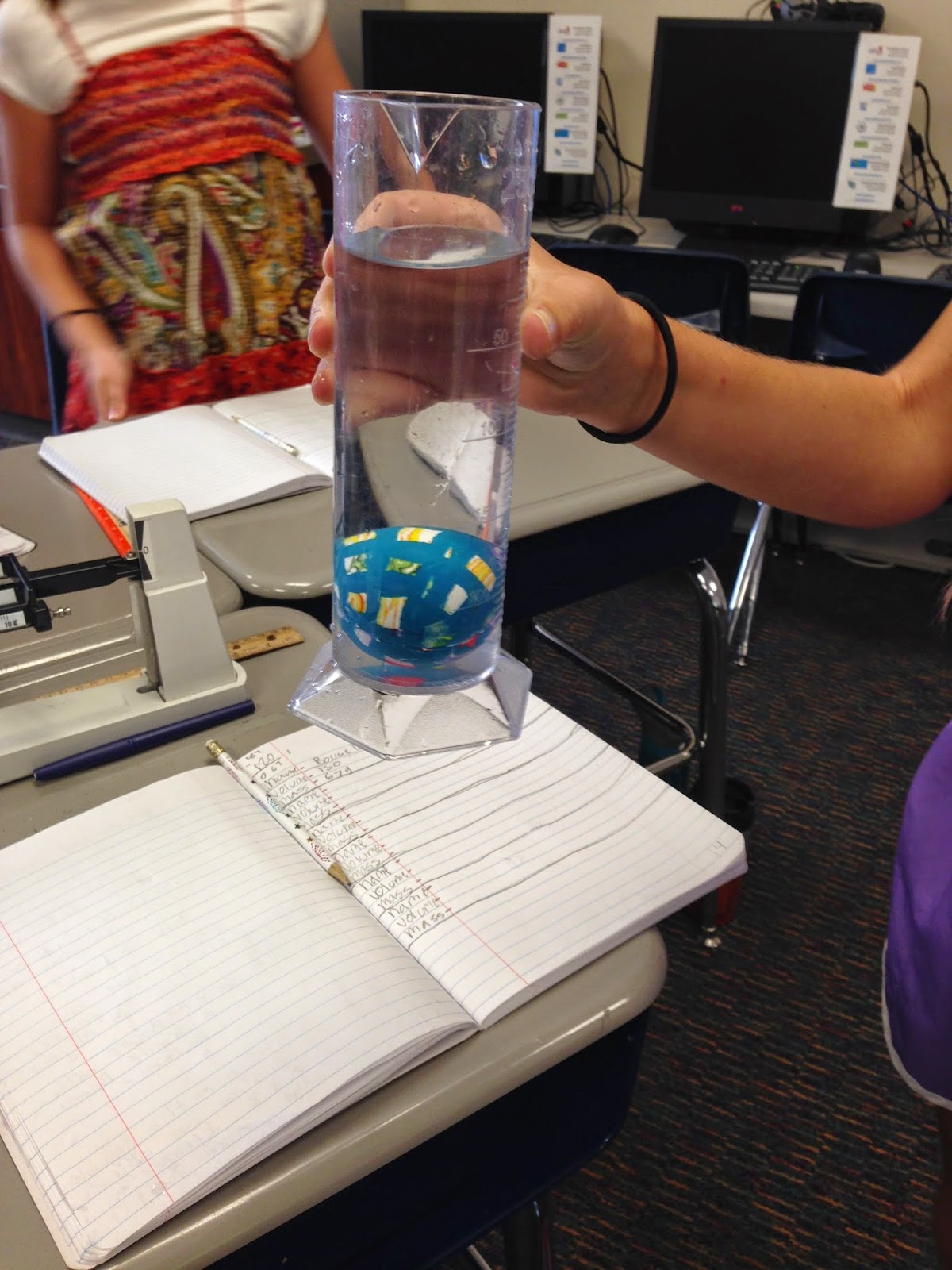
Volume and Mass
Today we practiced finding the mass and volume of different objects. First I asked the students to come up with some way to organize their information in their journals. Most eventually ended up with a table. To find the volume, we measured the water displacement after the object was placed in a graduated cylinder of 200 mL of water. To measure the mass, we used a triple beam balance. The most challenging object with regards to mass was the ball, which wouldn't stop rolling off the triple beam balance. Eventually the students realized they would need something to hold it. They chose a beaker, and figured out how to measure the mass of the ball without including the mass of the beaker - measure the mass of the beaker separately, measure the mass of the beaker and ball together, then subtract the mass of the beaker.
Wednesday, September 17, 2014
Glow Stick Investigation
![]() |
| Glow stick dipped in hot water |
![]() |
| Glow stick dipped in hot water |
![]() | |
| Glow stick dipped in hot water, then again in cold water at the bottom. You can see the difference! |
Posted by Rebecca May at 10:14 AM 0 comments
Labels: 4th grade, Particles, Science, Thermal Energy
Subscribe to:
Posts (Atom)