BLOGGER TEMPLATES AND TWITTER BACKGROUNDS »
Showing posts with label Mass. Show all posts

Friday, September 25, 2015

Matter Rotations


This week we reviewed mass, volume, and density, and also began discussing the idea of conductors of heat. (We'll talk more about conductors when we get to circuits.) The students went through rotations covering each topic.
Rotation #1 was a can of Coke and a can of Diet Coke, and the students placed them in a tub of water to measure distance each sank. The regular coke sank to the bottom, while the Diet Coke did not. This lead to a discussion about the mass of sugar versus the mass of artificial sweetener, and their relative densities. I brought in a sample of each so that the students could feel the difference in mass. It a BIG difference!
Rotation #2 included a wooden spoon, a plastic spoon, a rubber spoon, and a metal spoon. The students predicted which spoon(s) would be good conductors of heat, then we put the spoons in hot water for 1 minute. We took the spoons out and timed how long it took for a small piece of butter to begin melting when placed on the spoon. We quickly noticed the metal was by far the best conductor.
Rotation #3 was about predicting and measuring the volumes of different liquids.
Rotation #4 included measuring the mass of many different objects using a triple beam balance.


Thursday, September 17, 2015

Measuring, Comparing, and Contrasting Matter

When practicing our ability to measure, compare, and contrast objects, we began by observing a group of objects and listing out their physical properties. Physical properties are simply the observable characteristics of an object. Then the students tested to see if each object was magnetic or not. After we recorded our results, we thought about characteristics that might make an object magnetic, and if those characteristics ALWAYS make an object magnetic. For example, is an object magnetic simply because it feels like it is made of metal? 

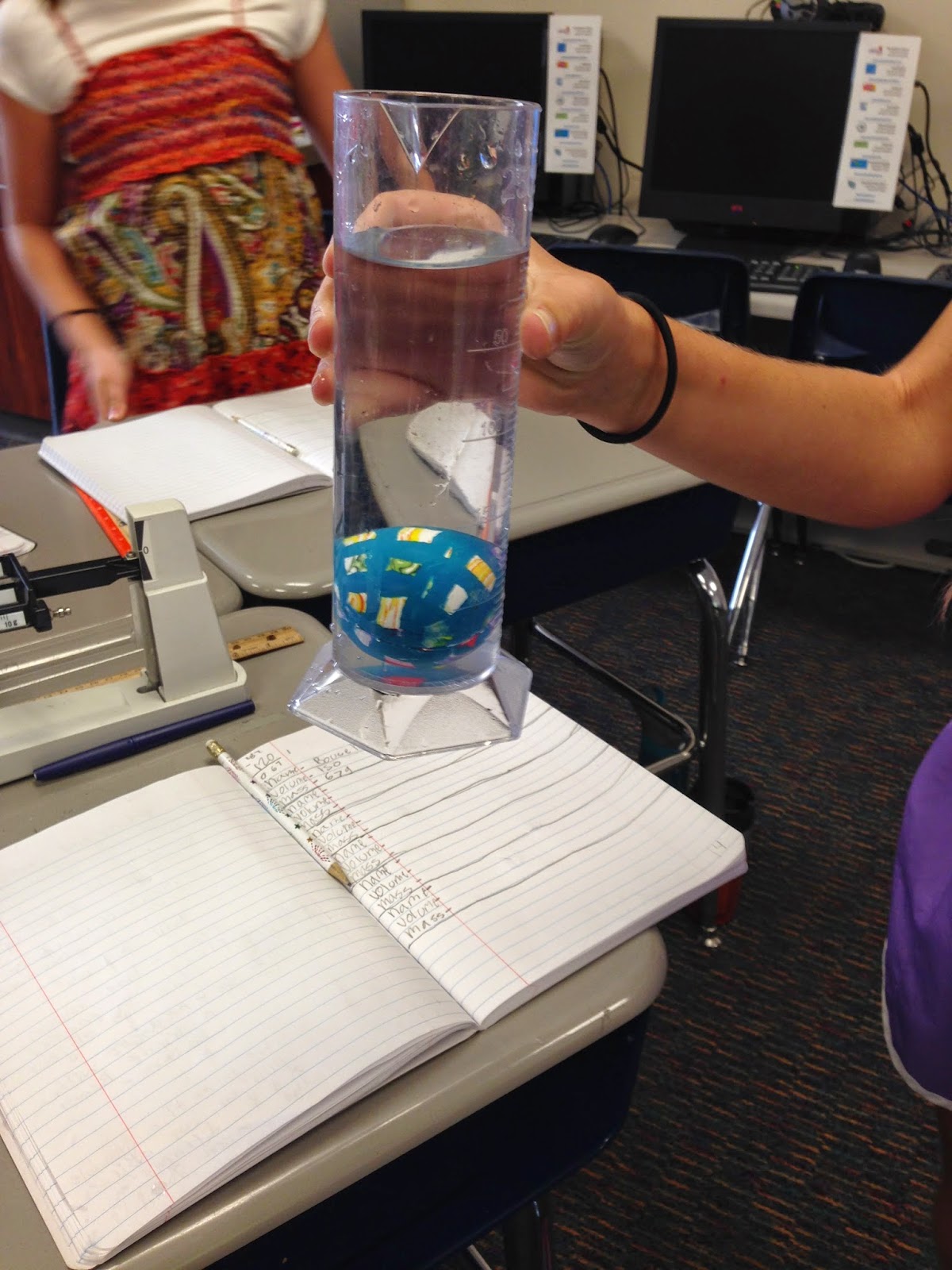
Next we moved to comparing matter based on volume, density, and states of matter. The students were given 6 vials containing mystery liquids (water, sand, cotton, baby oil, salt water, and air.) They found the mass of each vial in grams, then they found the volume of each container by measuring the water displacement after the vial was submerged in 200mL of water. Because all of our vials were the same, the vials should all have the same volume. Finally, the students put all six vials into a bucket of water to determine if they sink, float, or stay in the middle. What they found was that the vial of water floated in the middle. This led to a discussion of why. After lots of talking back and forth, the kids finally came to the conclusion that it was because the water in the vial has the same density as the water in which we put it. The sand and salt water sank because they are more dense than the water. The cotton, baby oil, and air floated on top because they are less dense than the water.

Our final discussion was led by these two questions: Does the state of matter affect whether an object sinks or floats? No, because we had solids that both sink and float and liquids that both sink and float. Does the mass affect whether an object sinks or floats? Yes, the higher masses sink, while the lower masses float.


Measuring Water Displacement
Density Test


Friday, September 26, 2014

Volume and Mass


Today we practiced finding the mass and volume of different objects. First I asked the students to come up with some way to organize their information in their journals. Most eventually ended up with a table. To find the volume, we measured the water displacement after the object was placed in a graduated cylinder of 200 mL of water. To measure the mass, we used a triple beam balance. The most challenging object with regards to mass was the ball, which wouldn't stop rolling off the triple beam balance. Eventually the students realized they would need something to hold it. They chose a beaker, and figured out how to measure the mass of the ball without including the mass of the beaker - measure the mass of the beaker separately, measure the mass of the beaker and ball together, then subtract the mass of the beaker.