BLOGGER TEMPLATES AND TWITTER BACKGROUNDS »

Monday, April 11, 2016

Symmetry

4th graders usually have a pretty good grasp on symmetry in shapes, though we do begin with a quick review.

Symmetry Journal Entry
We talk about what symmetry is, and also explore several shapes to find their lines of symmetry.


We move to finding lines of symmetry within letters. The kids are given a stack of capital letters, and must determine if they have a horizontal line of symmetry, vertical line of symmetry, both horizontal and vertical lines of symmetry, or no line of symmetry. We discuss the way our letters are made, and how if the letter were made differently the line of symmetry could change. For example, the way our B is printed, there is no line of symmetry. If the B had equal "humps" on the top and bottom, there would be a horizontal line of symmetry.
Symmetry of Letters


After this discussion, I challenge the kids to make words using only vertical lines of symmetry, as well as words using only horizontal lines of symmetry. This is quite the challenge! I do allow them to use the letters with no lines of symmetry in their words. Otherwise, horizontal is a tad difficult. ;)

Monday, March 28, 2016

Converting Units of Measurement


After lengthy discussions and explorations of different units of measurement regarding length, weight/mass, and capacity, we began to try to convert units of measurement. Ex. How many yards are in 18 feet?

To do this in an organized way, we used our handy T-chart. As we practiced several conversions, the children began to see the  multiplication and division relationship. Because we still sometimes get confused about when to multiply or divide to get our answers, we are still going to start with the T-chart so that our rule is more obvious. Then we may move to a higher-level operation than simply listing. Some children are still more comfortable listing than multiplying or dividing, but are making larger jumps to help them be more efficient.

We made our "Big G" to help us see the relationship between units of capacity.


Friday, March 4, 2016

Inherited Traits and Learned Characteristics

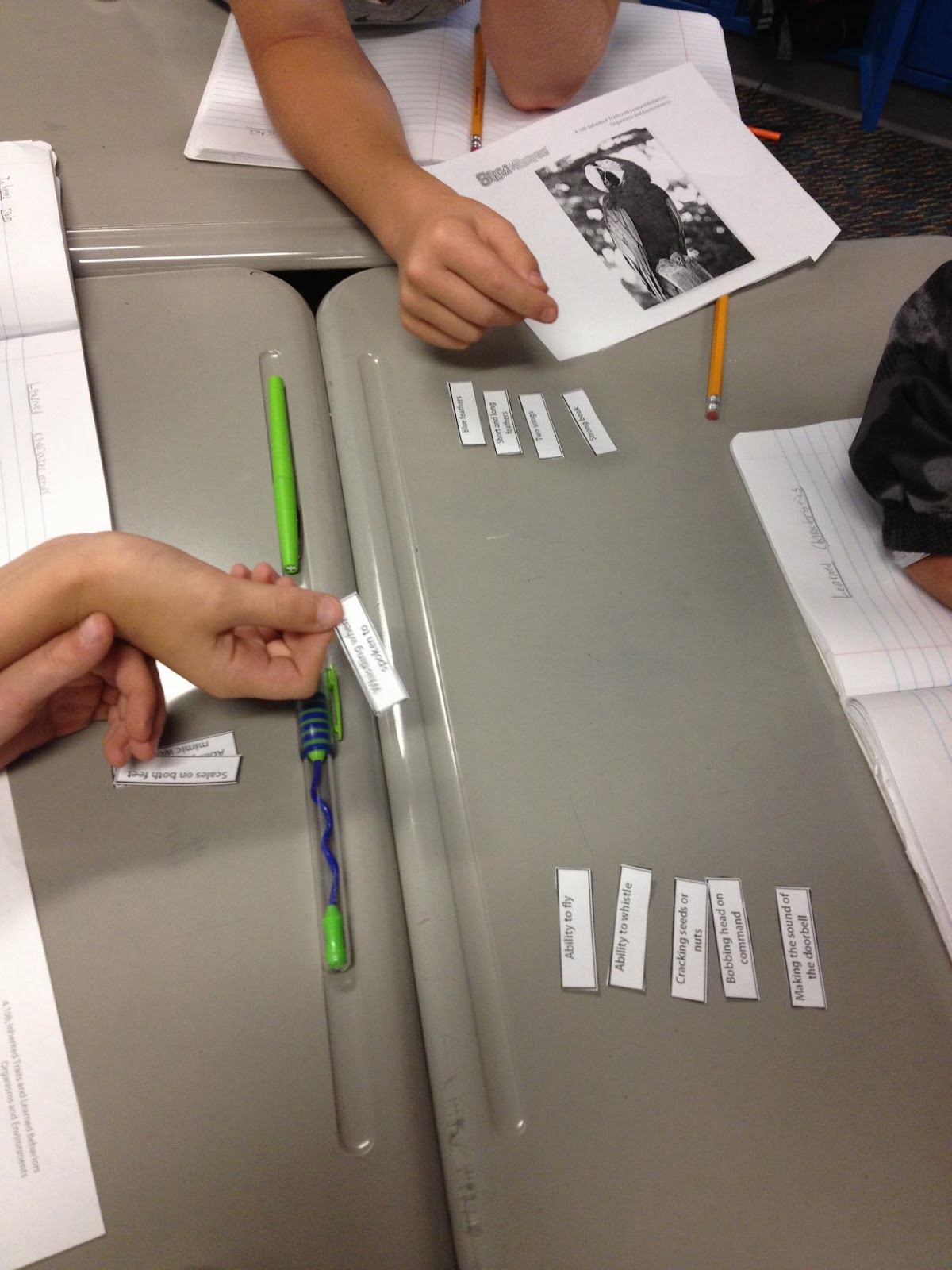
Today we discussed inherited traits and learned characteristics. Inherited traits are things we have/can do when we're born. Learned characteristics are those things we had to learn to do. We looked at a list of things a macaw is able to do, and determined if they were learned or inherited behaviors. Then we looked at lots of different pictures of various things (child rolling her tongue, color of a goldfish, freckles, ability to play an instrument) to make the distinction between inherited and learned.


Friday, February 19, 2016

Plant and Animal Adaptations

We did two investigations this week involving plant and animal adaptations. For plant adaptations, your kids were given different supplies (wax paper, plastic lid, balloon, sticky note, toothpick, crayon, cardboard piece). They were to try to determine which object was supposed to represent a plant adaptation shown on a sheet of plant pictures. This was really just an exploratory activity to help them evaluate why some materials might be more beneficial for plants than others.

Next we explored some bird beak adaptations by using tools to represent different bird beaks while trying to pick up various types of food. We used a clothespin to represent a finch beak, a toothpick to represent a woodpecker, a dropper to represent a hummingbird, and a spoon to represent a spoonbill. We then tried to pick up nectar (water), fish (plastic squares), seeds (sunflower seeds), and insects (raisins). This led to an interesting discussion regarding the fact bird beaks must fit the diet of the birds.


Tuesday, February 9, 2016

Camouflage

This week we researched different animals and how they camouflage themselves within their environment for protection. After our lesson, the students colored their own butterfly in a way that would allow it to blend in to our classroom. They came up with some pretty good ones! Can you spot the butterflies in the pictures?


Tuesday, January 5, 2016

The Phases of the Moon

Today we discussed the phases of the moon. We began by watching a really great video online that helps us understand why we see the different phases of the moon. You can find it here

We watched it several times, discussing why we're seeing what we're seeing as the camera moves. We then made our phases of the moon foldable shown here.

There are also some great demonstrations on YouTube! 

Friday, December 11, 2015

Equivalent Fractions

Equivalent fractions is all about self-discovery. After the kids have seen enough models of fractions, they really notice the equivalence of some of them on their own. This leads us to a discussion about why the fractions are equivalent - because they represent the same amount, they're just broken into differently-sized pieces. After drawing enough examples on their own, the kids realize there is a multiplication/division relationship as well. This saves them the time of drawing the pictures!

Our journal entry
Our class poster